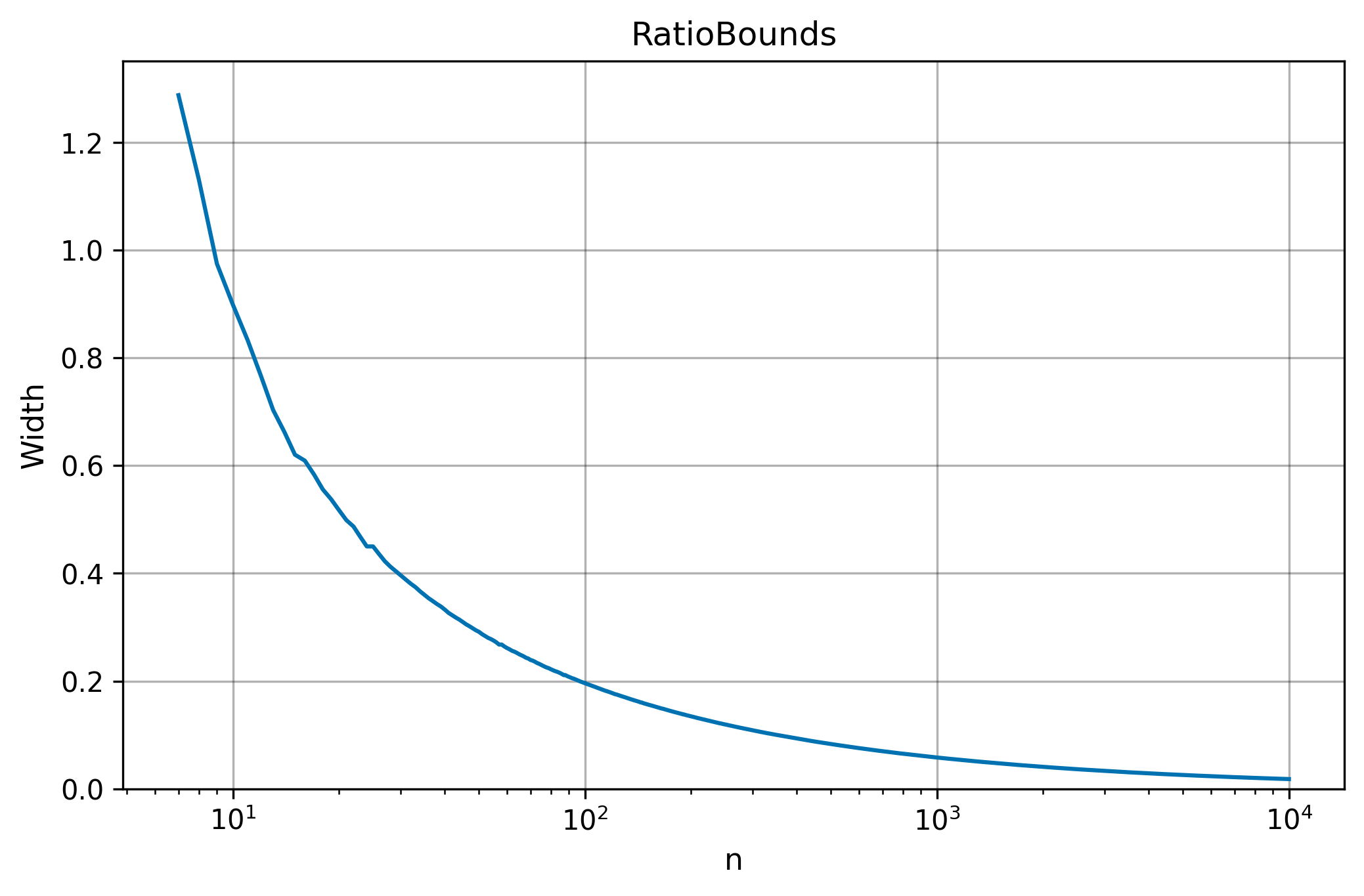
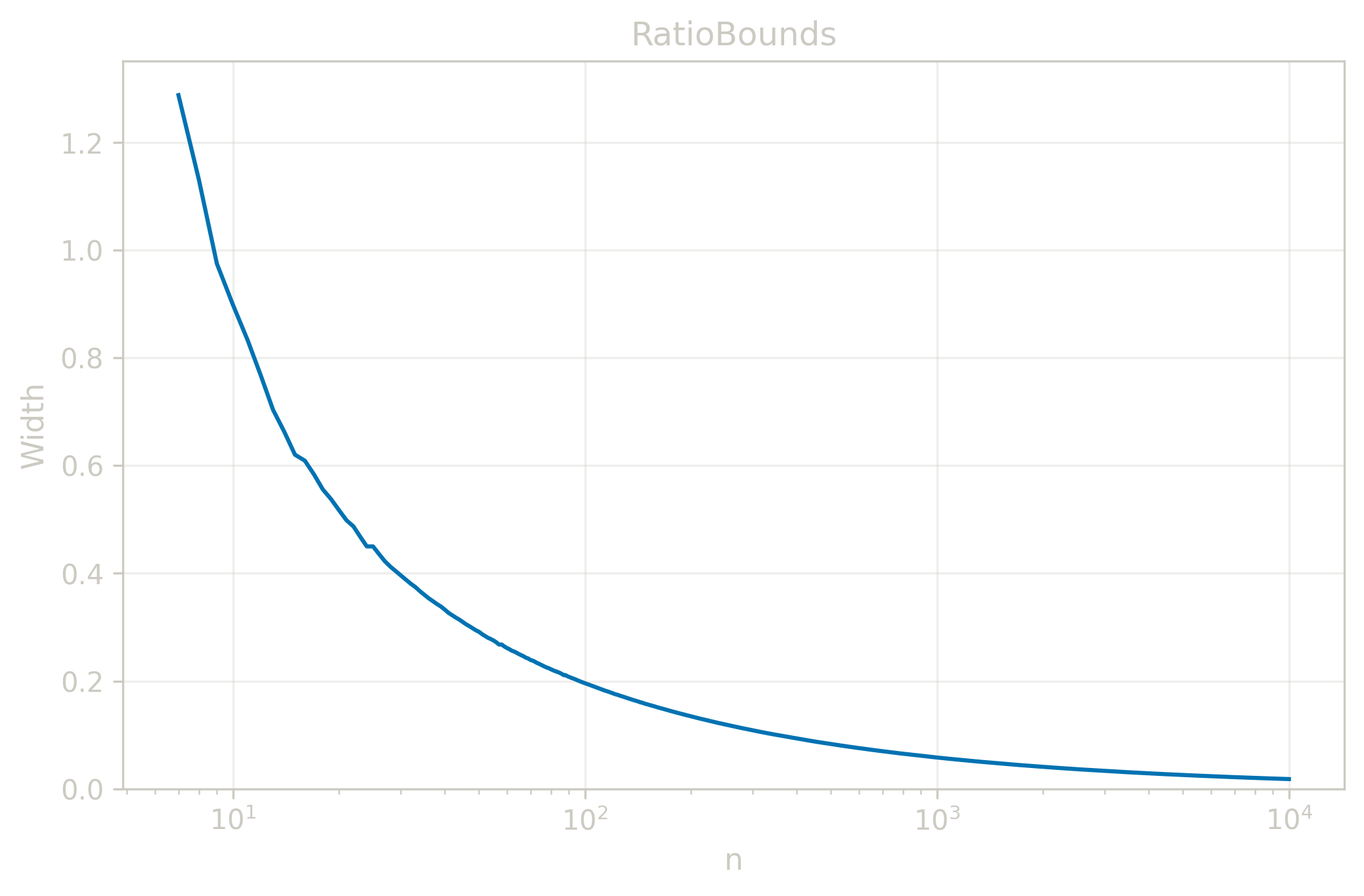
RatioBounds

RatioBounds(x,y,misrate)=exp(ShiftBounds(logx,logy,misrate))\operatorname{RatioBounds}(\mathbf{x}, \mathbf{y}, \mathrm{misrate}) = \exp(\operatorname{ShiftBounds}(\log \mathbf{x}, \log \mathbf{y}, \mathrm{misrate}))

Robust bounds on Ratio(x,y)\operatorname{Ratio}(\mathbf{x}, \mathbf{y}) with specified coverage — the multiplicative dual of ShiftBounds\operatorname{ShiftBounds}.

  • Also known as — distribution-free confidence interval for Hodges-Lehmann ratio
  • Interpretationmisrate\mathrm{misrate} is probability that true ratio falls outside bounds
  • Domainxi>0x_i > 0, yj>0y_j > 0, misrate2(n+mn)\mathrm{misrate} \geq \frac{2}{\binom{n+m}{n}}
  • Assumptionspositivity(x), positivity(y)
  • Unit — dimensionless
  • Note — assumes weak continuity (ties from measurement resolution are tolerated but may yield conservative bounds)

Properties

  • Scale invariance RatioBounds(kx,ky,misrate)=RatioBounds(x,y,misrate)\operatorname{RatioBounds}(k \cdot \mathbf{x}, k \cdot \mathbf{y}, \mathrm{misrate}) = \operatorname{RatioBounds}(\mathbf{x}, \mathbf{y}, \mathrm{misrate})
  • Scale equivariance RatioBounds(kxx,kyy,misrate)=(kxky)RatioBounds(x,y,misrate)\operatorname{RatioBounds}(k_x \cdot \mathbf{x}, k_y \cdot \mathbf{y}, \mathrm{misrate}) = (\frac{k_x}{k_y}) \cdot \operatorname{RatioBounds}(\mathbf{x}, \mathbf{y}, \mathrm{misrate})
  • Multiplicative antisymmetry RatioBounds(x,y,misrate)=1/RatioBounds(y,x,misrate)\operatorname{RatioBounds}(\mathbf{x}, \mathbf{y}, \mathrm{misrate}) = 1 / \operatorname{RatioBounds}(\mathbf{y}, \mathbf{x}, \mathrm{misrate}) (bounds reversed)

Example

  • RatioBounds([1..30], [10..40], 1e-4) where Ratio ≈ 0.5 yields bounds containing 0.50.5
  • Bounds fail to cover true ratio with probability misrate\approx \mathrm{misrate}

Relationship to ShiftBounds

RatioBounds\operatorname{RatioBounds} is computed via log-transformation:

RatioBounds(x,y,misrate)=exp(ShiftBounds(logx,logy,misrate))\operatorname{RatioBounds}(\mathbf{x}, \mathbf{y}, \mathrm{misrate}) = \exp(\operatorname{ShiftBounds}(\log \mathbf{x}, \log \mathbf{y}, \mathrm{misrate}))

This means if ShiftBounds\operatorname{ShiftBounds} returns [a,b][a, b] for the log-transformed samples, RatioBounds\operatorname{RatioBounds} returns [ea,eb][e^a, e^b].

RatioBounds\operatorname{RatioBounds} provides not just the estimated ratio but also the uncertainty of that estimate. The function returns an interval of plausible ratio values given the data. Set misrate\mathrm{misrate} to control how often the bounds might fail to contain the true ratio: use 10310^{-3} for everyday analysis or 10610^{-6} for critical decisions where errors are costly. These bounds require no assumptions about your data distribution, so they remain valid for any continuous positive measurements. If the bounds exclude 11, that suggests a reliable multiplicative difference between the two groups.

Algorithm

The RatioBounds\operatorname{RatioBounds} estimator uses the same log-exp transformation as Ratio, delegating to ShiftBounds in log-space:

RatioBounds(x,y,misrate)=exp(ShiftBounds(logx,logy,misrate))\operatorname{RatioBounds}(\mathbf{x}, \mathbf{y}, \mathrm{misrate}) = \exp(\operatorname{ShiftBounds}(\log \mathbf{x}, \log \mathbf{y}, \mathrm{misrate}))

The algorithm operates in three steps:

  • Log-transform Apply log\log to each element of both samples. Positivity is required so that the logarithm is defined.

  • Delegate to ShiftBounds Compute [a,b]=ShiftBounds(logx,logy,misrate)[a, b] = \operatorname{ShiftBounds}(\log \mathbf{x}, \log \mathbf{y}, \mathrm{misrate}). This provides distribution-free bounds on the shift in log-space.

  • Exp-transform Return [ea,eb][e^a, e^b], converting the additive bounds back to multiplicative bounds.

Because log\log and exp\exp are monotone, the coverage guarantee of ShiftBounds\operatorname{ShiftBounds} transfers directly: the probability that the true ratio falls outside [ea,eb][e^a, e^b] equals the probability that the true log-shift falls outside [a,b][a, b], which is at most misrate\mathrm{misrate}.

Tests

RatioBounds(x,y,misrate)=exp(ShiftBounds(logx,logy,misrate))\operatorname{RatioBounds}(\mathbf{x}, \mathbf{y}, \mathrm{misrate}) = \exp(\operatorname{ShiftBounds}(\log \mathbf{x}, \log \mathbf{y}, \mathrm{misrate}))

The RatioBounds\operatorname{RatioBounds} test suite contains 61 correctness test cases (3 demo + 9 natural + 6 property + 10 edge + 9 multiplic + 4 uniform + 5 misrate + 15 unsorted). Since RatioBounds\operatorname{RatioBounds} returns bounds rather than a point estimate, tests validate that the bounds contain Ratio(x,y)\operatorname{Ratio}(\mathbf{x}, \mathbf{y}) and satisfy equivariance properties. Each test case output is a JSON object with lower and upper fields representing the interval bounds. All samples must contain strictly positive values. The domain constraint misrate2(n+mn)\mathrm{misrate} \geq \frac{2}{\binom{n+m}{n}} is enforced; inputs violating this return a domain error.

Demo examples (n=m=5n = m = 5, positive samples) — 3 tests:

  • demo-1: x=(1,2,3,4,5)\mathbf{x} = (1, 2, 3, 4, 5), y=(2,3,4,5,6)\mathbf{y} = (2, 3, 4, 5, 6), misrate=0.05\mathrm{misrate} = 0.05
  • demo-2: x=(1,2,3,4,5)\mathbf{x} = (1, 2, 3, 4, 5), y=(2,3,4,5,6)\mathbf{y} = (2, 3, 4, 5, 6), misrate=0.01\mathrm{misrate} = 0.01, expected: wider bounds than demo-1
  • demo-3: x=(2,3,4,5,6)\mathbf{x} = (2, 3, 4, 5, 6), y=(2,3,4,5,6)\mathbf{y} = (2, 3, 4, 5, 6), misrate=0.05\mathrm{misrate} = 0.05, expected: bounds containing 11 (identity case)

These cases illustrate how tighter misrates produce wider bounds and validate the identity property where identical samples yield bounds containing one.

Natural sequences ([n,m]in5,8,10×5,8,10[n, m] in {5, 8, 10} \times {5, 8, 10}, misrate=102\mathrm{misrate} = 10^{-2}) — 9 combinations:

  • natural-5-5: x=(1,,5)\mathbf{x} = (1, \ldots, 5), y=(1,,5)\mathbf{y} = (1, \ldots, 5), expected bounds containing 11
  • natural-5-8: x=(1,,5)\mathbf{x} = (1, \ldots, 5), y=(1,,8)\mathbf{y} = (1, \ldots, 8)
  • natural-5-10: x=(1,,5)\mathbf{x} = (1, \ldots, 5), y=(1,,10)\mathbf{y} = (1, \ldots, 10)
  • natural-8-5: x=(1,,8)\mathbf{x} = (1, \ldots, 8), y=(1,,5)\mathbf{y} = (1, \ldots, 5)
  • natural-8-8: x=(1,,8)\mathbf{x} = (1, \ldots, 8), y=(1,,8)\mathbf{y} = (1, \ldots, 8), expected bounds containing 11
  • natural-8-10: x=(1,,8)\mathbf{x} = (1, \ldots, 8), y=(1,,10)\mathbf{y} = (1, \ldots, 10)
  • natural-10-5: x=(1,,10)\mathbf{x} = (1, \ldots, 10), y=(1,,5)\mathbf{y} = (1, \ldots, 5)
  • natural-10-8: x=(1,,10)\mathbf{x} = (1, \ldots, 10), y=(1,,8)\mathbf{y} = (1, \ldots, 8)
  • natural-10-10: x=(1,,10)\mathbf{x} = (1, \ldots, 10), y=(1,,10)\mathbf{y} = (1, \ldots, 10), expected bounds containing 11

These sizes are chosen to satisfy misrate2(n+mn)\mathrm{misrate} \geq \frac{2}{\binom{n+m}{n}} for all combinations.

Property validation (n=m=10n = m = 10, misrate=103\mathrm{misrate} = 10^{-3}) — 6 tests:

  • property-identity: x=(1,2,,10)\mathbf{x} = (1, 2, \ldots, 10), y=(1,2,,10)\mathbf{y} = (1, 2, \ldots, 10), bounds must contain 11
  • property-scale-2x: x=(2,4,,20)\mathbf{x} = (2, 4, \ldots, 20), y=(1,2,,10)\mathbf{y} = (1, 2, \ldots, 10), bounds must contain 22
  • property-reciprocal: x=(1,2,,10)\mathbf{x} = (1, 2, \ldots, 10), y=(2,4,,20)\mathbf{y} = (2, 4, \ldots, 20), bounds must contain 0.50.5 (reciprocal of scale-2x)
  • property-common-scale: x=(10,20,,100)\mathbf{x} = (10, 20, \ldots, 100), y=(20,40,,200)\mathbf{y} = (20, 40, \ldots, 200)
  • Same ratio as property-reciprocal (common scale invariance)
  • property-small-values: x=(0.1,0.2,,1.0)\mathbf{x} = (0.1, 0.2, \ldots, 1.0), y=(0.2,0.4,,2.0)\mathbf{y} = (0.2, 0.4, \ldots, 2.0)
  • Same ratio as property-reciprocal (small value handling)
  • property-mixed-scales: x=(0.01,0.1,1,10,100,1000,0.5,5,50,500)\mathbf{x} = (0.01, 0.1, 1, 10, 100, 1000, 0.5, 5, 50, 500), y=(0.1,1,10,100,1000,10000,5,50,500,5000)\mathbf{y} = (0.1, 1, 10, 100, 1000, 10000, 5, 50, 500, 5000)
  • Wide range validation

Edge cases — boundary conditions and extreme scenarios (10 tests):

  • edge-min-samples: x=(2,3,4,5,6)\mathbf{x} = (2, 3, 4, 5, 6), y=(3,4,5,6,7)\mathbf{y} = (3, 4, 5, 6, 7), misrate=0.05\mathrm{misrate} = 0.05
  • edge-permissive-misrate: x=(1,2,3,4,5)\mathbf{x} = (1, 2, 3, 4, 5), y=(2,3,4,5,6)\mathbf{y} = (2, 3, 4, 5, 6), misrate=0.5\mathrm{misrate} = 0.5 (very wide bounds)
  • edge-strict-misrate: n=m=20n = m = 20, misrate=106\mathrm{misrate} = 10^{-6} (very narrow bounds)
  • edge-unity-ratio: n=m=10n = m = 10, all values =5= 5, misrate=103\mathrm{misrate} = 10^{-3} (bounds around 1)
  • edge-asymmetric-3-100: n=3n = 3, m=100m = 100, misrate=102\mathrm{misrate} = 10^{-2} (extreme size difference)
  • edge-asymmetric-5-50: n=5n = 5, m=50m = 50, misrate=103\mathrm{misrate} = 10^{-3} (highly unbalanced)
  • edge-duplicates: x=(3,3,3,3,3)\mathbf{x} = (3, 3, 3, 3, 3), y=(5,5,5,5,5)\mathbf{y} = (5, 5, 5, 5, 5), misrate=102\mathrm{misrate} = 10^{-2} (all duplicates, bounds around 0.6)
  • edge-wide-range: n=m=10n = m = 10, values spanning 10310^{-3} to 10810^8, misrate=103\mathrm{misrate} = 10^{-3} (extreme value range)
  • edge-tiny-values: n=m=10n = m = 10, values 106\approx 10^{-6}, misrate=103\mathrm{misrate} = 10^{-3} (numerical precision)
  • edge-large-values: n=m=10n = m = 10, values 108\approx 10^8, misrate=103\mathrm{misrate} = 10^{-3} (large magnitude)

These edge cases stress-test boundary conditions, numerical stability, and the margin calculation with extreme parameters.

Multiplic distribution ([n,m]in10,30,50×10,30,50[n, m] in {10, 30, 50} \times {10, 30, 50}, misrate=103\mathrm{misrate} = 10^{-3}) — 9 combinations with Multiplic(1,0.5)\underline{\operatorname{Multiplic}}(1, 0.5):

  • multiplic-10-10, multiplic-10-30, multiplic-10-50
  • multiplic-30-10, multiplic-30-30, multiplic-30-50
  • multiplic-50-10, multiplic-50-30, multiplic-50-50
  • Random generation: x\mathbf{x} uses seed 0, y\mathbf{y} uses seed 1

These fuzzy tests validate that bounds properly encompass the ratio estimate for realistic log-normally-distributed data at various sample sizes.

Uniform distribution ([n,m]in10,100×10,100[n, m] in {10, 100} \times {10, 100}, misrate=104\mathrm{misrate} = 10^{-4}) — 4 combinations with Uniform(1,10)\underline{\operatorname{Uniform}}(1, 10):

  • uniform-10-10, uniform-10-100, uniform-100-10, uniform-100-100
  • Random generation: x\mathbf{x} uses seed 2, y\mathbf{y} uses seed 3
  • Note: positive range [1,10)[1, 10) used for ratio compatibility

The asymmetric size combinations are particularly important for testing margin calculation with unbalanced samples.

Misrate variation (n=m=20n = m = 20, x=(1,2,,20)\mathbf{x} = (1, 2, \ldots, 20), y=(2,4,,40)\mathbf{y} = (2, 4, \ldots, 40)) — 5 tests with varying misrates:

  • misrate-1e-2: misrate=102\mathrm{misrate} = 10^{-2}
  • misrate-1e-3: misrate=103\mathrm{misrate} = 10^{-3}
  • misrate-1e-4: misrate=104\mathrm{misrate} = 10^{-4}
  • misrate-1e-5: misrate=105\mathrm{misrate} = 10^{-5}
  • misrate-1e-6: misrate=106\mathrm{misrate} = 10^{-6}

These tests use identical samples with varying misrates to validate the monotonicity property: smaller misrates (higher confidence) produce wider bounds. The sequence demonstrates how bound width increases as misrate decreases, helping implementations verify correct margin calculation.

Unsorted tests — verify independent sorting of x\mathbf{x} and y\mathbf{y} (15 tests):

  • unsorted-x-natural-5-5: x=(5,3,1,4,2)\mathbf{x} = (5, 3, 1, 4, 2), y=(1,2,3,4,5)\mathbf{y} = (1, 2, 3, 4, 5), misrate=102\mathrm{misrate} = 10^{-2} (X reversed, Y sorted)
  • unsorted-y-natural-5-5: x=(1,2,3,4,5)\mathbf{x} = (1, 2, 3, 4, 5), y=(5,3,1,4,2)\mathbf{y} = (5, 3, 1, 4, 2), misrate=102\mathrm{misrate} = 10^{-2} (X sorted, Y reversed)
  • unsorted-both-natural-5-5: x=(5,3,1,4,2)\mathbf{x} = (5, 3, 1, 4, 2), y=(5,3,1,4,2)\mathbf{y} = (5, 3, 1, 4, 2), misrate=102\mathrm{misrate} = 10^{-2} (both reversed)
  • unsorted-x-shuffle-5-5: x=(3,1,5,4,2)\mathbf{x} = (3, 1, 5, 4, 2), y=(1,2,3,4,5)\mathbf{y} = (1, 2, 3, 4, 5), misrate=102\mathrm{misrate} = 10^{-2} (X shuffled)
  • unsorted-y-shuffle-5-5: x=(1,2,3,4,5)\mathbf{x} = (1, 2, 3, 4, 5), y=(4,2,5,1,3)\mathbf{y} = (4, 2, 5, 1, 3), misrate=102\mathrm{misrate} = 10^{-2} (Y shuffled)
  • unsorted-both-shuffle-5-5: x=(3,1,5,4,2)\mathbf{x} = (3, 1, 5, 4, 2), y=(2,4,1,5,3)\mathbf{y} = (2, 4, 1, 5, 3), misrate=102\mathrm{misrate} = 10^{-2} (both shuffled)
  • unsorted-demo-unsorted-x: x=(5,1,4,2,3)\mathbf{x} = (5, 1, 4, 2, 3), y=(2,3,4,5,6)\mathbf{y} = (2, 3, 4, 5, 6), misrate=0.05\mathrm{misrate} = 0.05 (demo-1 X unsorted)
  • unsorted-demo-unsorted-y: x=(1,2,3,4,5)\mathbf{x} = (1, 2, 3, 4, 5), y=(6,2,5,3,4)\mathbf{y} = (6, 2, 5, 3, 4), misrate=0.05\mathrm{misrate} = 0.05 (demo-1 Y unsorted)
  • unsorted-demo-both-unsorted: x=(4,1,5,2,3)\mathbf{x} = (4, 1, 5, 2, 3), y=(5,2,6,3,4)\mathbf{y} = (5, 2, 6, 3, 4), misrate=0.05\mathrm{misrate} = 0.05 (demo-1 both unsorted)
  • unsorted-identity-unsorted: x=(4,1,5,2,3)\mathbf{x} = (4, 1, 5, 2, 3), y=(5,1,4,3,2)\mathbf{y} = (5, 1, 4, 3, 2), misrate=102\mathrm{misrate} = 10^{-2} (identity property, both unsorted)
  • unsorted-scale-unsorted: x=(10,30,20)\mathbf{x} = (10, 30, 20), y=(15,5,10)\mathbf{y} = (15, 5, 10), misrate=0.5\mathrm{misrate} = 0.5 (scale relationship, both unsorted)
  • unsorted-asymmetric-5-10: x=(2,5,1,3,4)\mathbf{x} = (2, 5, 1, 3, 4), y=(10,5,2,8,4,1,9,3,7,6)\mathbf{y} = (10, 5, 2, 8, 4, 1, 9, 3, 7, 6), misrate=102\mathrm{misrate} = 10^{-2} (asymmetric sizes, both unsorted)
  • unsorted-duplicates: x=(3,3,3,3,3)\mathbf{x} = (3, 3, 3, 3, 3), y=(5,5,5,5,5)\mathbf{y} = (5, 5, 5, 5, 5), misrate=102\mathrm{misrate} = 10^{-2} (all duplicates, any order)
  • unsorted-mixed-duplicates-x: x=(2,1,3,2,1)\mathbf{x} = (2, 1, 3, 2, 1), y=(1,1,2,2,3)\mathbf{y} = (1, 1, 2, 2, 3), misrate=102\mathrm{misrate} = 10^{-2} (X has unsorted duplicates)
  • unsorted-mixed-duplicates-y: x=(1,1,2,2,3)\mathbf{x} = (1, 1, 2, 2, 3), y=(3,2,1,3,2)\mathbf{y} = (3, 2, 1, 3, 2), misrate=102\mathrm{misrate} = 10^{-2} (Y has unsorted duplicates)

These unsorted tests are critical because RatioBounds\operatorname{RatioBounds} computes bounds from pairwise ratios, requiring both samples to be sorted independently. The variety ensures implementations dont incorrectly assume pre-sorted input or sort samples together. Each test must produce identical output to its sorted counterpart, validating that the implementation correctly handles the sorting step.

No performance testRatioBounds\operatorname{RatioBounds} uses the FastRatio\text{FastRatio} algorithm internally, which delegates to FastShift\text{FastShift} in log-space. Since bounds computation involves only two quantile calculations from the pairwise differences (at positions determined by PairwiseMargin\operatorname{PairwiseMargin}), the performance characteristics are equivalent to computing two Ratio\operatorname{Ratio} estimates, which completes efficiently for large samples.